Before a Nation Rises, It Kneels
At America’s 250th, the image of Washington on his knees is a reminder that prayer is not the end of a covenant journey. It is the doorway.
- By Ken Krogue
- — 5 min read
The strongest image of Washington may not be Washington on horseback.
It may not be Washington crossing the Delaware, presiding over the Constitutional Convention, or standing before a nation that would one day call him the father of his country.
It may be Washington on his knees.
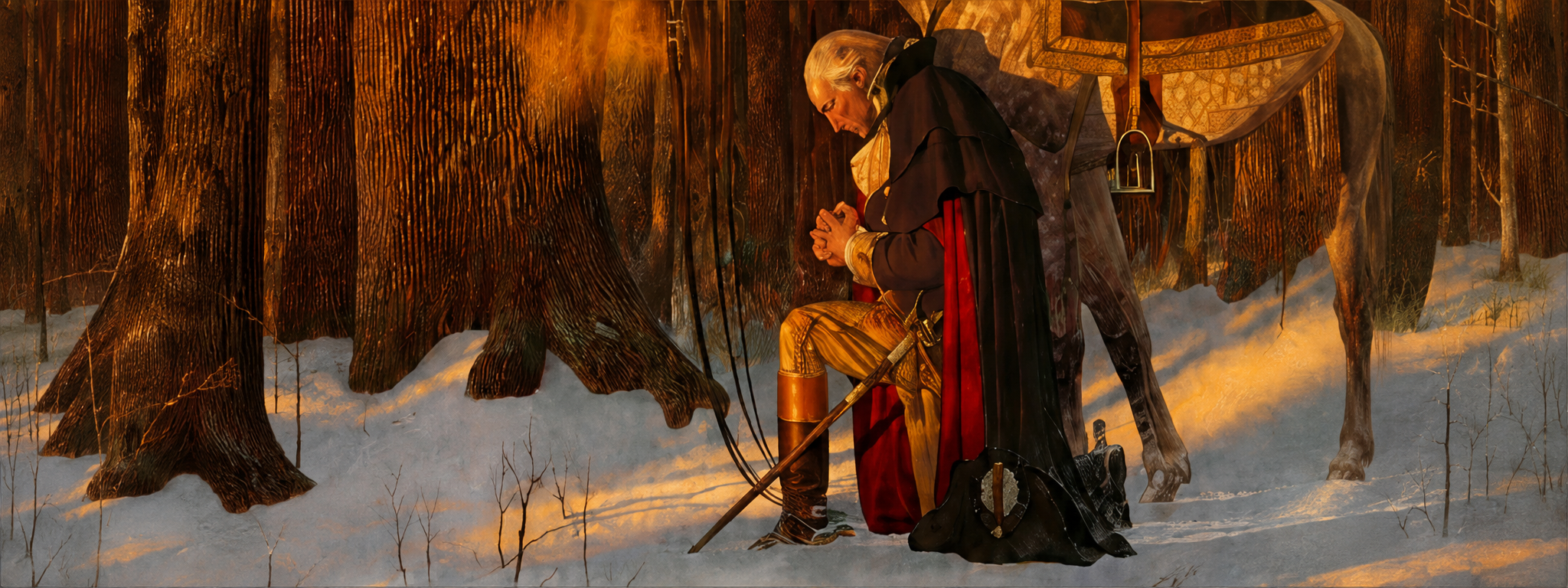
Arnold Friberg’s The Prayer at Valley Forge shows Washington kneeling in the snow beneath the weight of command. The winter is cold. The army is suffering. The cause is uncertain. And the man history remembers as strong is shown first as humble. [1]
The painting does not prove every detail of the tradition it depicts, and that is not the claim. Its enduring power is the truth it asks us to consider: leadership under God does not begin with self-confidence. It begins with dependence.
Before Washington stood before men, Friberg shows him kneeling before God.
That is not weakness. That is appeal.
We noticed
The 2026 National Day of Prayer drew its theme verse from 1 Chronicles 16 — David’s song of thanksgiving as the Ark of the Covenant came home: “Tell of His glory among the nations, His wonderful deeds among all the peoples.” Its official artwork set those words beside Friberg’s kneeling Washington. [2]
Scripture supplied the words. Washington’s image supplied the posture.
We noticed.
We should not force more meaning onto that pairing than the sources support. But we should not miss the invitation it places before us either: remember God’s works, tell the next generation, and begin in humility.
This is not an invitation to make America an object of worship, to turn prayer into a partisan badge, or to claim that one painting proves God’s judgment on our time. It is a simpler and harder invitation: to remember that every nation, movement, church, and family is made of people who need wisdom beyond themselves. Washington’s kneeling image endures because public strength without private humility eventually becomes performance.
On May 7, as people gathered across the country for the National Day of Prayer, we chose to begin The American Covenant Project’s public journey the same way — not with a campaign launch, but with prayer.
Before we asked anyone to walk with us, we appealed to God.
Prayer is the doorway
Scripture names the movement.
First, humility: “If my people… shall humble themselves, and pray, and seek my face…” [3]
Then, choice: “Choose you this day whom ye will serve.” [4]
Then, the path: “Ask for the old paths, where is the good way, and walk therein.” [5]
Humility before God. Choice before the soul. A path before the people.
Nephi saw that order play out on this very land. Six hundred years before Christ, he watched Gentiles cross the waters and then watched them fight for it. Before the battle, he recorded the posture: they “did humble themselves before the Lord; and the power of the Lord was with them.” Then they “were delivered by the power of God out of the hands of all other nations.” [6]
Humbled first. Delivered second.
Prayer is not the end of the journey. It is the doorway.
That matters, because remembrance can turn sentimental. We can admire Washington kneeling, celebrate a national anniversary, echo a familiar verse, and still dodge the harder question: what will prayer change in us?
Covenant prayer is not merely asking God to preserve what we already prefer. It is placing ourselves under His direction. It asks us to remember the Giver, to receive responsibility along with the gift, and to return when we have drifted.
That return begins close to home.
A country prays through its people. People learn to pray in homes, congregations, and communities. Children learn what prayer means by hearing parents and grandparents name their gratitude, confess their dependence, ask for wisdom, and then act on what they receive.
This is where the national becomes personal: a child hearing a grandparent pray; a family remembering why liberty matters; a home where faith becomes conversation instead of decoration; people turning back to God together. It can start as small as a parent pausing before a meal, or a grandmother speaking one name aloud to God and asking the children to carry it in prayer through the week.
Begin where you are
You do not need a national stage to begin.
Gather your family. Read 1 Chronicles 16. Ask each person to name one blessing worth remembering and one burden worth carrying upward. Pray for your home, your community, and your country. Then choose one faithful action that should follow the prayer.
The National Day of Prayer Task Force provides official resources for family, church, and community prayer. Use them. Support the people doing the work. Let a national invitation become a household practice. [2]
Then keep walking.
A single prayer will not solve every national problem. But prayer rightly offered can reorder the people who must face those problems. It can trade self-confidence for dependence, anxiety for responsibility, and noise for enough stillness to hear the next faithful step.
America’s 250th is more than fireworks and slogans. It can become a moment of return.
Washington’s kneeling image still asks its question. Will strength bow before God? Will remembrance become responsibility? Will one generation teach the next where to turn when human strength runs out?
The Book of Mormon gives us the same posture beneath a banner. Before Captain Moroni went out among the people waving the title of liberty, “he bowed himself to the earth, and he prayed mightily unto his God for the blessings of liberty to rest upon his brethren.” [7]
He knelt. Then he raised the flag.
Before a nation rises, it kneels.
Before we asked anyone to walk with us, we appealed to Heaven.
Now we begin.
Source Notes
[1] Museum of the Bible, “The Prayer at Valley Forge’s 50th Anniversary” — Verifies that Arnold Friberg created the painting for the 1976 Bicentennial and that it portrays Washington kneeling in solitary prayer during the Valley Forge winter. This article treats the painting as an artistic and moral doorway, not as proof of every detail of the historical tradition.
[2] National Day of Prayer Task Force, “2026 Theme” — Verifies the May 7, 2026 observance, the theme “Glorify God Among the Nations, Seeking Him in All Generations,” the 1 Chronicles 16:24 theme verse, its David/Ark context, and authorized use of Friberg’s painting in the official artwork.
[3] 2 Chronicles 7:14.
[4] Joshua 24:15.
[5] Jeremiah 6:16.
[6] 1 Nephi 13:16–19.
[7] Alma 46:12–13, 19–20.
Choose where to walk next:
TROWEL & MUSKET NEWSLETTER