
A Preacher, A Printer, And The Voice That Helped Wake A People
Sight & Sound’s film A Great Awakening reminds us that before liberty was written into law, it had to awaken in the hearts of the people.
- By Ken Krogue
- —
- — 5 min read
Before America had a president, it had preachers.
Before Washington led an army, George Whitefield crossed the colonies with a voice that gathered thousands in the open air. Scripture gives us a category for preparatory voices: “Prepare ye the way of the Lord, make his paths straight.” [1]
Lehi quoted those words six centuries before John the Baptist fulfilled them. They are the first time Isaiah’s voice surfaces in the Book of Mormon: a prophet “should go forth and cry in the wilderness: Prepare ye the way of the Lord.” [1]
We should be careful with language like that. Whitefield was not Washington. He did not lead the army, preside over the Constitutional Convention, refuse a crown, or become the father of a nation.
He preached.
But sometimes a preacher comes first: a voice before the institution, a call before the country, an awakening before a founding.
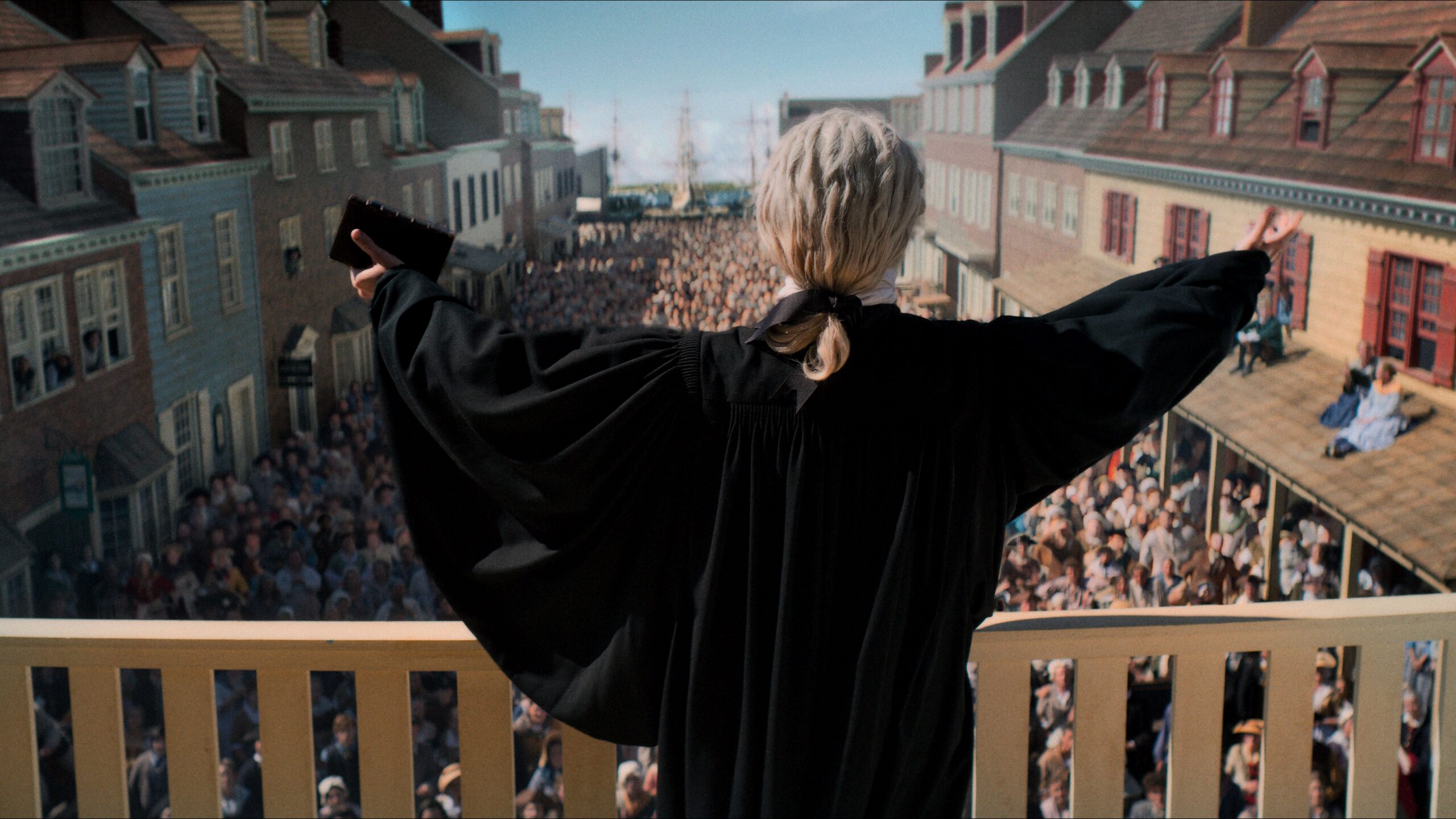
That is why we are grateful Sight & Sound brought A Great Awakening to the screen. The film follows Whitefield and his unlikely friendship with Benjamin Franklin. We would rather not retell it here; the point is to send you to the film, not to stand in for it. But it is worth explaining why this story caught our attention. [2]
We notice things.
Like when a film about a preacher and a printer arrives in the middle of America’s 250th-anniversary remembrance. A preacher with no microphone. A printer with a press. And a claim about reach that is hard to read quickly: some historians estimate that roughly 80 percent of American colonists heard Whitefield preach at least once. Applied to the U.S. Census Bureau’s historical estimate for the colonial population in 1770, that comes to more than 1.6 million people—an estimate, not an attendance record, but a staggering one. [3]
Why this story? Why now?
A story worth recovering
Most Americans know Benjamin Franklin. At least they think they do: the kite, the key, the spectacles, the printing press, the wit, the face on the hundred-dollar bill.
Fewer Americans know George Whitefield. That is strange, because Christian History Institute calls him America’s first celebrity. [4] He held no office, commanded no army, and wrote no founding document. He preached Christ, repentance, scripture, and liberty of the soul across towns, churches, streets, and open fields with a force that moved people by the thousands. [3] [4]
That is not just religious influence. That is mass reach before mass media.
No microphone. No radio. No television. No YouTube. No algorithm. Just a voice carried from town to town—and a printer curious enough to measure what was happening.
Franklin once backed away from one of Whitefield’s outdoor sermons, step by step, until he could no longer make out the words, and then reasoned from the distance how large a crowd that single voice could reach. His answer ran to the tens of thousands. [5] Picture it: a preacher proclaiming scripture in the open air, and a printer at the edge of the crowd, quietly measuring the sound.
Whitefield had the voice. Franklin had the press. The awakening traveled.

The pattern is simple, and it still holds. Conviction needs a voice. A movement needs a way to travel. A sermon can gather a crowd; a press can carry the message far beyond the field.
Latter-day Saints have seen this pattern before. About ninety years after Franklin printed Whitefield, another printer set type in Palmyra, New York. On March 26, 1830, the first copies of a five-thousand-copy run of the Book of Mormon went on sale from E. B. Grandin’s shop. Isaiah had seen that day: “in that day shall the deaf hear the words of the book.” It was the “great and a marvelous work among the children of men” that Nephi saw. [8]
“How shall they hear?”
The Apostle Paul asked, “How shall they hear without a preacher?” [6]
In Whitefield’s case, they heard because he would not stop preaching.
Also watch: No Microphone. Thousands Could Still Hear Him. · A Printer, a Preacher, and a Growing Awakening
This is one reason A Great Awakening matters. Before liberty can be defended in law, it has to be awakened in conscience. Before people can keep freedom, they have to know what freedom is for. Before a nation can be formed, hearts have to be reached.
America’s founding is usually told through politics, law, philosophy, economics, war, and constitutional design. All of that matters. But it is not the whole story. There was also preaching. There was scripture. There was repentance. There was revival. There were families hearing psalms sung in their own streets and ordinary people asking what kind of souls they were becoming. The awakening did not stay in the fields. It came home. [5]
So let this story come home, too. Watch the film with your family. Ask what gave one voice such reach. Ask why Franklin—who said Whitefield never converted him—respected him, printed his work, and remained his friend until Whitefield’s death. Then ask the harder question: what messages reach our homes now, who is carrying them, and what are they forming in us?
Then open scripture. Read Romans 10 together. Talk about what it means to hear, to believe, to remember, and to act. History becomes something more when a parent, a grandparent, and a child sit down and ask together which voices deserve their attention—and which truths they want their home to keep. The screen is not the destination. The conversation is.
Then read Joseph Smith—History 1:5–14. Revival did not end with Whitefield. It came back in waves, and one of them reached a fourteen-year-old boy who read James 1:5 and walked into the woods to ask.
Start with the film
We are grateful to Sight & Sound for carrying this story into a season of national remembering. A Great Awakening is available to rent through Sight & Sound TV, along with official material that helps a family understand the story and how it was made. [2] [7]
But start with the film.
Support the creators. Watch it with people you love. Let the preacher, the printer, and the awakening become a conversation in your home.
Before liberty was written into law, it had to awaken in the hearts of the people.
That is a story worth noticing.
Especially now.
Source Notes
[1] Matthew 3:3, Isaiah 40:3, and 1 Nephi 10:7–8—Source for the opening scripture phrase, “Prepare ye the way of the Lord, make his paths straight.”
[2] A Great Awakening official website and Sight & Sound TV—Official film framing, the George Whitefield / Benjamin Franklin premise, Sight & Sound ownership, and rental availability.
[3] Christian History Institute, “George Whitefield: Did You Know?” and the U.S. Census Bureau’s historical population reporting—Sources for the estimate that about 80 percent of American colonists heard Whitefield preach and for the estimated colonial population of 2,148,076 in 1770. The resulting 1.6-million figure is a mathematical application of the historical estimate, not a direct attendance count.
[4] Bill of Rights Institute, “The Great Awakening,” and Christian History Institute—Historical background on Whitefield’s itinerant, open-air preaching and his unusual fame in the colonies.
[5] National Humanities Center, “Benjamin Franklin on Rev. George Whitefield, 1739”—Franklin’s firsthand account of Whitefield’s voice, his reasoning about how large a crowd could hear it, their lifelong civil friendship, and Franklin’s printing of Whitefield’s sermons and journals.
[6] Romans 10:14—Source for “How shall they hear without a preacher?”
[7] America250 and Sight & Sound TV—National 250th-anniversary context and the official film rental and supporting materials.
[8] Isaiah 29:14, 18; 1 Nephi 14:7; The Papers of Benjamin Franklin (Founders Online); and Church History Photographs, “Grandin Press and Print Shop”—Sources for “the deaf hear the words of the book,” for “a great and a marvelous work among the children of men,” for Franklin’s first volumes of Whitefield’s sermons and journals appearing in 1740, and for the 5,000-copy first edition of the Book of Mormon, with finished copies available March 26, 1830.
Choose where to walk next:
TROWEL & MUSKET NEWSLETTER