
How Sight & Sound’s A Great Awakening reveals the scale, the mechanism, and the timing behind a story worth hearing again at America’s 250th.
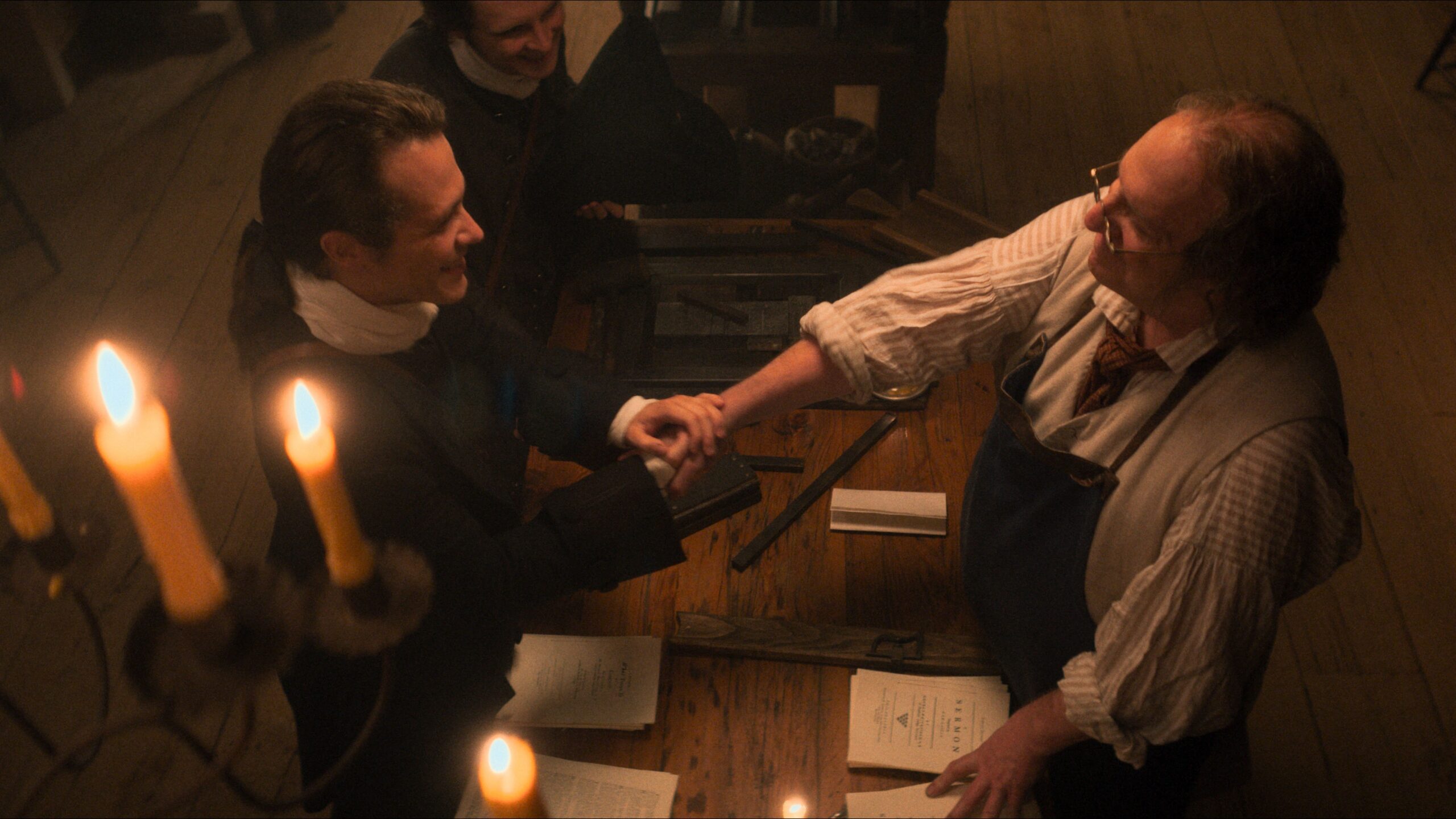
The first thing to understand about George Whitefield is scale.
Christian History Institute reports that about 80 percent of American colonists heard Whitefield preach at least once. [1] That is a remarkable claim on its own—but a broad percentage can slip past a reader without landing. So narrow it until it can be felt.
A U.S. Census Bureau historical estimate places the colonial population in 1770 at 2,148,076. Apply 75 to 80 percent to that figure and the illustrative range is roughly 1.6 to 1.7 million people. [2]
Hold that estimate loosely and honestly. It is not a census of sermon attendance. Whitefield’s ministry ran across decades, the colonial population kept changing, and the percentage comes from historical interpretation rather than a ledger of names. It is a reasoned scale estimate, not an audited count. But even with every caution in place, the scale is hard to wave away.
Whitefield did not reach that many people through broadcast towers, podcasts, social platforms, or paid promotion. He preached in churches when the pulpits were open to him, and in streets and fields when they were not. Contemporary accounts describe crowds in the tens of thousands. He became one of the first widely recognized public figures in colonial America. [1] [3]
That is mass reach before mass media.
No microphone. No radio. No television. No YouTube. No algorithm. A human voice had to carry across an open crowd—and then, if it was going to matter, the message had to travel after the crowd went home.
Then Franklin measured the voice
Benjamin Franklin did more than hear Whitefield. He observed him.
In his autobiography, Franklin described Whitefield’s voice as loud, clear, and precisely articulated. During an outdoor sermon in Philadelphia, Franklin walked backward down Market Street until the noise near Front Street finally swallowed the words. Then he estimated the area from which the preacher could still be heard and reasoned that more than 30,000 people might hear him at once. [4]
A later acoustic analysis found Franklin’s method surprisingly sound, while noting that his assumptions about how tightly the crowd packed in were generous and that background noise mattered a great deal. The point is not that every reported crowd caught every word. The point is that Franklin treated communication reach as something a person could observe, measure, and test. [5]
That is not trivia. That is the hinge.
Film excerpt from Sight & Sound’s A Great Awakening, shared on The Covenant Project’s YouTube channel. “No Microphone. Thousands Could Still Hear Him.” Retrieved October 12, 2026: 21,302 views · 1,857 likes · 43 comments.
Franklin was a printer, scientist, organizer, inventor, entrepreneur, and public thinker. Whitefield was an itinerant preacher under deep religious conviction. They did not share a theology. Franklin called theirs a sincere “civil Friendship” and vouched for Whitefield’s integrity, even as he admitted plainly that the preacher’s prayers had never converted him. And Franklin printed Whitefield’s sermons and journals. [4]
Whitefield had the voice. Franklin had the press. The awakening traveled.

Also watch: A Printer, a Preacher, and a Growing Awakening on TCP’s channel, then watch the complete film through Sight & Sound TV.
It is more than a tidy summary. It names the mechanism. A voice gathers people in one place. Print carries the message beyond that place. Repetition builds recognition. Distribution extends influence. What might have stayed a scattered series of local sermons became something closer to a shared colonial experience.
When conviction finds distribution, movements travel.
Why Sight & Sound matters here
That mechanism is part of what makes Sight & Sound’s choice of story so fitting.
Sight & Sound began nearly fifty years ago in rural Pennsylvania and grew from multimedia presentations into large-scale biblical stage productions, two theaters, a streaming platform, and a film studio. It describes its mission as telling His story through who they are and what they do, and Sight & Sound Films now produces feature films about historical figures whose lives were changed by Christ. [6] [7]
A Great Awakening is directed by Joshua Enck, who co-wrote the film with Jeff Bender and Jonathan Blair. Jonathan Blair portrays George Whitefield, and John Paul Sneed portrays Benjamin Franklin. Roadside Attractions handled the theatrical release. [8]
Those details matter because this is not simply a historical subject chosen to reach a faith audience. It sits at the meeting point of Sight & Sound’s long experience with biblical storytelling, its newer film work, and a national anniversary that invites Americans to look again at what formed a people before a nation was founded.
Because the film is now available at home, we can talk about its premise, its historical setting, its creators, and its production more freely than we could before release. But the goal is still to preserve the experience, not to spend it. We are not here to summarize the plot or explain every turn. We are here to give you enough to see why the work deserves your attention—and then to point you to the people who made it. [9]
The timing matters
The official film site frames A Great Awakening around America’s 250th anniversary, and America250 describes the national commemoration as a chance to reflect on the country’s past, honor the people who shaped it, and consider the future being handed to the next generation. [10]
That timing changes the questions a reader brings to this story—and the responsibility they feel after it.
Anniversaries can become fireworks and slogans. They can also become mirrors.
What kind of people were being formed before America was born? What had they heard? What had stirred them? What language of liberty, conscience, repentance, and responsibility had already entered colonial life? And what voices are forming our families now?
The Great Awakening does not explain the whole American founding, and it should not be asked to. Politics, law, philosophy, economics, war, and constitutional design all matter. Whitefield was not Washington, and a revival meeting was not a constitutional convention. Keeping those categories distinct protects both the history and the faith.
But it is just as incomplete to tell the founding story as if preaching, scripture, repentance, and religious awakening were only background noise. Franklin himself described a visible change in Philadelphia: people who had seemed indifferent to religion began singing psalms in their homes, until you could hardly walk an evening street without hearing them. [4]
Before a people could decide what kind of country they might build, many were already being asked what kind of souls they were becoming.
Nephi saw that preparation coming. Six centuries before Christ, he watched “the Spirit of God” work upon Gentiles who “went forth out of captivity, upon the many waters” (1 Nephi 13:13).
Awakening was part of the preparation from the start.
Where to begin
Start with the film.
Watch A Great Awakening on Sight & Sound TV or on Wonder Project through Prime Video, and let the creators introduce Whitefield, Franklin, and their unlikely friendship through the medium they built for it. Then, if you want more, Sight & Sound’s official pages offer the trailer and behind-the-scenes features on the characters, the costumes, the Market Street set, the original hymn, and Franklin’s lightning storm—a second layer that never requires a scene-by-scene recap from us. [9] [11]
After watching, carry the story home. Ask why one preacher’s voice traveled so far. Ask why a printer bothered to measure it and then chose to print it. Ask what happens when conviction and distribution meet. Then ask the closer question: what voices now have access to your family, and what are they teaching you to love, to fear, to remember, or to forget?
Then open the sources. Read Franklin’s own account. Read the history of the Great Awakening. Open Romans 10 and ask again, “How shall they hear?” The film can open a door; scripture, history, and honest family conversation are what carry the work further.
Paul answered his own question by reaching back to Isaiah (Romans 10:15): “How beautiful upon the mountains are the feet of him that bringeth good tidings, that publisheth peace” (Isaiah 52:7). The Book of Mormon returns to that verse again and again. Abinadi applied it to every prophet: “these are they who have published peace, who have brought good tidings of good, who have published salvation” (Mosiah 15:14).
Publish. The voice and the press were always meant to work together.
Sight & Sound’s wider 2026 work offers other official doorways as well. JOSHUA is playing in Lancaster, Pennsylvania, through December 31, 2026, and JOSHUA—Live! comes to movie theaters nationwide beginning October 30. In Branson, Missouri, Miracle of Christmas runs November 3 through December 31. [12]
The screen is not the destination. The stage is not the destination. Better media matters because of what a family does after the credits, after the curtain, and after the song follows them home.
Whitefield’s voice gathered the crowd. Franklin’s press extended the reach. Sight & Sound has carried the story into another medium, in another moment of national remembering.
A preacher. A printer. A people beginning to awaken.
The pattern is more substantial than it first appears.
And now we know where to begin.
Source Notes
[1] Christian History Institute, “George Whitefield: Did You Know?”—Reports that about 80 percent of American colonists heard Whitefield preach at least once, describes him as America’s first celebrity, and notes his friendship with Franklin, his seven American journeys, and his extensive preaching.
https://christianhistoryinstitute.org/magazine/article/george-whitefield-did-you-know
[2] U.S. Census Bureau, “July 2026: America Celebrates 250 Years,” and Historical Statistics of the United States: Colonial Times to 1970, Chapter Z—Place the estimated colonial population in 1770 at 2,148,076. The 1.6–1.7 million range is an illustrative mathematical application of the 75–80 percent historical estimate, not a direct attendance record.
https://www.census.gov/about/history/stories/monthly/2026/july-2026.html
https://www2.census.gov/library/publications/1975/compendia/hist_stats_colonial-1970/hist_stats_colonial-1970p2-chZ.pdf
[3] Bill of Rights Institute, “The Great Awakening”—Scholar-reviewed overview of Whitefield’s itinerant preaching, open-air crowds, evangelical conversion, and the colonial Great Awakening.
https://billofrightsinstitute.org/essays/the-great-awakening/
[4] National Humanities Center, “Benjamin Franklin on Rev. George Whitefield, 1739”—Reproduces Franklin’s account of Whitefield’s preaching, the visible religious response in Philadelphia, their civil friendship, Franklin’s printing of Whitefield’s sermons and journals, and his estimate that more than 30,000 could hear the preacher.
https://nationalhumanitiescenter.org/pds/becomingamer/ideas/text2/franklinwhitefield.pdf
[5] Acoustical Society of America, “George Whitefield and the Detection of the Human Voice” analysis—Reconstructs Franklin’s experiment, finds his overall method reasonably sound, and explains the importance of crowd density, background noise, and site conditions.
https://acoustics.org/pressroom/httpdocs/166th/1aAA4_Boren.html
[6] Sight & Sound, “Our Story”—Official history of Sight & Sound, including its beginnings, stage theaters, Sight & Sound TV, film studio, and mission.
https://www.sight-sound.com/story
[7] Sight & Sound Films—Official description of its feature-film work and its focus on true stories of historical figures changed by Christ.
https://www.sight-sound.com/films
[8] Roadside Attractions, “A Great Awakening”—Official theatrical-distributor credits for director Joshua Enck; writers Joshua Enck, Jeff Bender, and Jonathan Blair; producers Steve Buckwalter and Troy Thorne; and starring cast including John Paul Sneed, Jonathan Blair, and Josh Bates.
https://roadsideattractions.com/filmography/agreatawakening/
[9] Sight & Sound TV and Wonder Project on Prime Video, “A Great Awakening”—Sight & Sound TV features the film, offered through subscription or pay-per-view (confirmed on the live site October 12, 2026), along with official supporting materials, including the trailer, Heart of the Story, Character Spotlight, Making Market Street, Creating the Costumes, Creating the Hymn, and Lightning Storm. The Christian Post reported in summer 2026 that the film is also streaming on Wonder Project through Prime Video.
https://watchwonderproject.com/
https://www.sight-sound.tv/a-great-awakening
[10] A Great Awakening official site and America250—Official film framing around America’s 250th and the official national commemoration context.
https://www.agreatawakening.com/
https://america250.org/
[11] A Great Awakening official website—Official watch, trailer, DVD, film details, study-guide, and related links.
https://www.agreatawakening.com/
[12] Sight & Sound Theatres, official show and ticketing pages—JOSHUA in Lancaster, March through December 31, 2026; Miracle of Christmas in Branson, November 3 through December 31, 2026; and JOSHUA—Live! in movie theaters nationwide beginning October 30.
https://www.sight-sound.com/shows
https://www.sight-sound.com/branson
https://www.sight-sound.com/ticketing
https://www.sight-sound.com/ticketing/JOS26/calendar