How Wonder Project, Jon Erwin, and Human / AI / Human filmmaking may give biblical and historical stories the scale they deserve — without surrendering the human beings called to tell them.
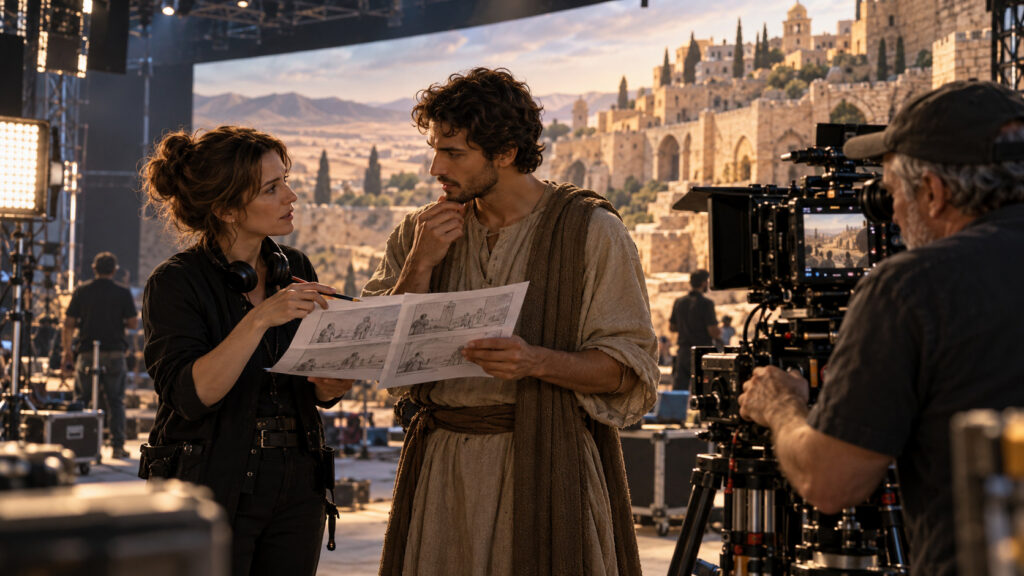
Biblical epics are expensive. So are historical dramas.
Armies, cities, deserts, palaces, battlefields, crowds, ships, ancient worlds, and vanished civilizations do not arrive cheaply. For generations, that cost shaped which stories could be attempted, who was allowed to attempt them, and how much of the vision had to be surrendered before a camera ever rolled. The old question was whether stories of scripture, covenant, family, liberty, courage, and Providence could ever afford the scale they deserve.
A new answer is forming. Maybe the tools have arrived just in time.
Wonder is testing the boundary
Wonder Project has already shown that faith-and-values storytelling can be cinematic, ambitious, premium, and global. Prime Video reports that the first two seasons of House of David drew more than 40 million viewers worldwide, and the series reached number one on Prime Video in the United States. A third and final season is on the way, though no premiere date has been announced. The first season premiered in February 2025 and the second in October 2025, so a 2027 arrival is a reasonable guess, but only a guess. [1] [4]
That matters because scale changes imagination. A generation raised on massive fantasy worlds should not be taught that scripture must always look smaller, flatter, cheaper, or less emotionally serious than the fictional universes surrounding it.
The Bible does not lack scale. Our production models have.
Jon Erwin and Wonder Project are now testing a different model through Innovative Dreams — a filmmaker-led production company, research lab, post-production operation, and visual-effects firm built with Luma and supported by Amazon Web Services. [1] [2] They call the model Realtime Hybrid Filmmaking, and its first project, The Old Stories: Moses, a three-part companion story from the world of House of David starring Ben Kingsley and O-T Fagbenle, premiered on Wonder Project through Prime Video on May 14, 2026. [2] [5]
Old story. New tool. The order matters.
What the tool is supposed to do
Luma’s official announcement says the workflow combines traditional filmmaking with generative AI, performance capture, virtual production, visual effects, and real-time editorial decisions. Actors can see and respond to developing digital environments, and the process shortens the distance between shooting, rendering, editing, and the final image. [2]
But the most important line is not technical. Jon Erwin says the work is about human collaboration and creativity — preserving the brilliance of actors’ performances, expanding what filmmakers can attempt, and bringing jobs back to Los Angeles. [2]
That is the right hierarchy.
God is the source. Truth is the message. Human beings remain the stewards. Technology is the tool.
Jesus Christ is the center of the truths these tools are meant to serve. The tools matter only insofar as they help faithful creators point families toward Him, His word, and the covenants that bind us to God.
Any system that reverses that order will eventually deform the work. But when the order is right, leverage is not the enemy of faith.
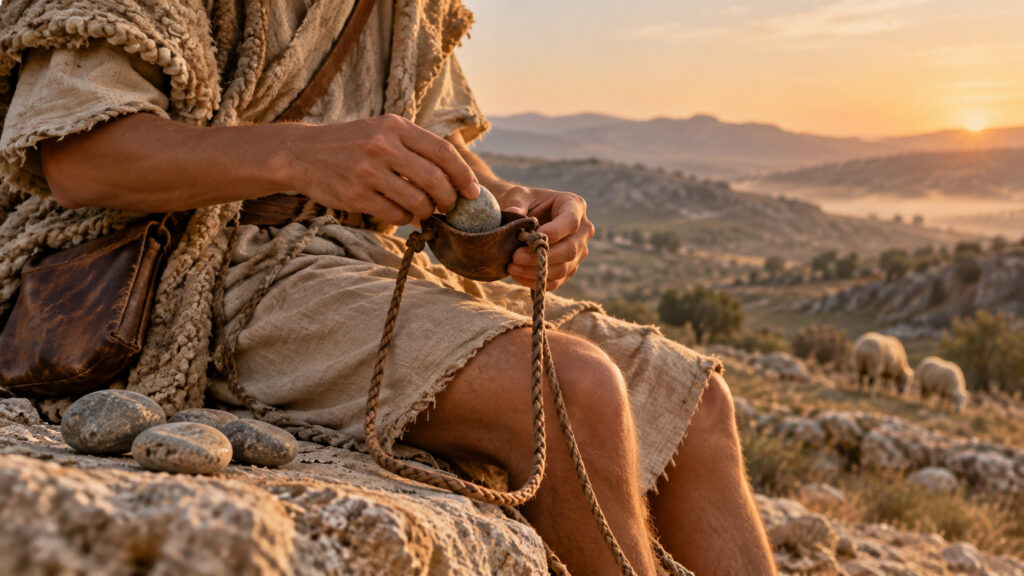
David carried a sling
The sling did not call David. It did not give him courage. It did not choose the stone, face the giant, or trust the living God. David did.
But the sling mattered. It extended trained human skill. It carried the stone farther and faster than a bare hand could throw. It was a tool already proven in the field, consecrated in the moment, and governed by the person holding it.
Faith does not despise leverage. It consecrates it.
The Book of Mormon gives an even older picture. The brother of Jared did the human work first: he “did molten out of a rock sixteen small stones.” Then he carried them up the mountain and asked, “touch these stones, O Lord, with thy finger, and prepare them that they may shine forth in darkness” (Ether 3:1, 4). And the Lord “touched the stones one by one with his finger” (Ether 3:6).
Human preparation. Divine light. The order still holds.
That is the proper way to think about AI in creative work. Not as prophet. Not as author. Not as master. As tool, as servant, as leverage under stewardship.
Scale is not the same as spectacle
The goal is not to make every sacred story louder. Scale is justified when it helps the audience enter the world, feel the cost of a choice, understand the danger, and remember the truth. A larger image cannot rescue a hollow story. Faster production cannot replace disciplined research. A convincing digital city cannot supply covenant meaning.
The tool earns its place when it serves the story. That is why the human order cannot be an afterthought. The writer must know what the scene means. The actor must carry the soul of the moment. The director must know where the audience should look. The historian and scriptural adviser must guard what the image claims. Technology can widen the canvas. It cannot decide what is sacred.
Human / AI / Human
The American Covenant Project’s governing model is simple: Human first. AI assists. Human last. [3]
The first human sets intention, meaning, responsibility, source, theology, voice, and the definition of done. AI may help research, compare, organize, visualize, test, accelerate, or generate possibilities. The final human judges what is true, what is beautiful, what belongs, what must be rejected, and what may be placed before a family.
Human stewardship first. AI as capable servant. Human judgment last.
The Lord taught Oliver Cowdery the same order: “you have supposed that I would give it unto you, when you took no thought save it was to ask me. But, behold, I say unto you, that you must study it out in your mind; then you must ask me if it be right” (Doctrine and Covenants 9:7–8).
No tool removes that responsibility.
That structure does not weaken the artist. It protects the artist from becoming a passenger inside his own work. Writers must remain writers, actors actors, directors directors. Designers, editors, musicians, craftspeople, historians, teachers, and parents must remain human beings exercising gifts, conscience, accountability, and judgment before God.
The machine does not carry covenant. People do.
Fear is not stewardship
The world is worried about AI, and not without reason. Every powerful tool can be corrupted. Images can be counterfeited. Voices can be stolen. Truth can be buried under volume. Artists can be exploited. Institutions can chase speed while destroying the people who gave the work its soul. Those dangers are real.
But fear is not stewardship.
Standing outside the field does not prevent the battle. It only guarantees that someone else chooses the weapons, writes the rules, trains the models, and shapes the imagination of our children. The printing press was contested. Radio was contested. Television, film, and the Internet were contested. AI will be contested too. Every one of those tools carried darkness. Every one also carried truth.
The question is not whether AI will be used. It will be. The question is who will govern it, what will govern them, and what they will build.
The Pattern is in the timing
At the same moment old stories are returning, the tools capable of giving them new scale are arriving. House of David brings a shepherd, worshipper, warrior, sinner, and future king into millions of homes. The Old Stories: Moses reaches farther back, into deliverance, law, covenant, and the forming of a people. Young Washington returns national memory to the screen. The storytellers are gathering. The audience is moving. The gates are opening. And now the tools are changing.
This is not random.
God is moving pieces on the board.
That is not a coincidence. That is a Pattern.
We should not stand in front of that Pattern apologizing for the existence of a tool. We should pick it up, place it under covenant, source, scripture, discipline, and human judgment, and use it to build what once seemed impossible.
What should families ask?
Families do not need to master every production technology. They do need to learn the right questions. Who made this? What human beings carried responsibility for it? What sources governed the story? What was created, reconstructed, generated, or altered? Were actors and artists honored? Did the tools deepen truth, or merely create spectacle? What does the work invite us to love, remember, believe, or become?
Those questions turn passive consumption into discernment. They also create a better audience for better creators.
Support the builders
Wonder Project and Innovative Dreams are not asking families to admire a software demonstration. They are building stories. Start with the work. Watch House of David and The Old Stories: Moses through their official pathways. Follow Wonder Project’s continuing experiments. Read what the filmmakers say they are trying to preserve. Support the artists, actors, crews, and storytellers willing to enter this new field without surrendering the old truths. [1] [2]
Then bring the question home. What could faithful creators build if the cost barriers fell? What stories have waited because the armies, cities, seas, temples, and ancient worlds were too expensive to realize? What would happen if the newest tools were governed by the oldest covenants?
The answer should not be a future without human creators. It should be a future in which more faithful human creators can build at the scale of their calling.
The newest tools can help return families to the oldest truths.
It is time to stop arriving late.
Pick up the sling. The battle is the Lord’s.
Source Notes
[1] Wonder Project, “About Us” — Verifies Wonder Project’s mission and leadership; identifies Jon Erwin as founder, chief creative officer, and CEO of Innovative Dreams; describes Realtime Hybrid Filmmaking as combining performance capture and virtual production accelerated by generative AI to amplify human creativity.
https://watchwonderproject.com/about-us
[2] Luma, “Wonder Project and Luma Launch Innovative Dreams,” April 16, 2026 — Verifies the company structure, Amazon Web Services support, the Realtime Hybrid Filmmaking description, the real-time editorial workflow, the human-collaboration and actor-performance emphasis, and The Old Stories: Moses as the first project using the workflow.
https://lumalabs.ai/news/luma-innovative-dreams
[3] CORE: Human / AI / Human Writing System V1 — Internal Covenant Project governing framework for human intention and stewardship, AI assistance, and final human judgment. This is an internal framework, not an external factual claim.
[4] Prime Video and Wonder Project, House of David Season 3 renewal, July 2026, as reported by Movieguide and MovieWeb — Verifies that the first two seasons together drew more than 40 million viewers worldwide, that the first season became the number-one show on Prime Video, and that Season 3 is the final season of the trilogy. No premiere date had been announced as of October 12, 2026. Season 1 premiered February 27, 2025, and Season 2 in October 2025; the 2027 estimate in the body is an inference from that pattern, not an announcement.
https://www.movieguide.org/news-articles/house-of-david-renewed-for-season-3.html
https://movieweb.com/house-of-david-amazon-final-season-3/
[5] Collider, “Wonder Project’s New 3-Part ‘House of David’ Companion Special Sets May 14 Release Date on Prime Video,” 2026 — Verifies the May 14, 2026 premiere of The Old Stories: Moses exclusively on Wonder Project’s subscription through Prime Video in the United States.
https://collider.com/ben-kingsley-the-old-stories-moses-trailer-poster-wonder-project-prime-video/