
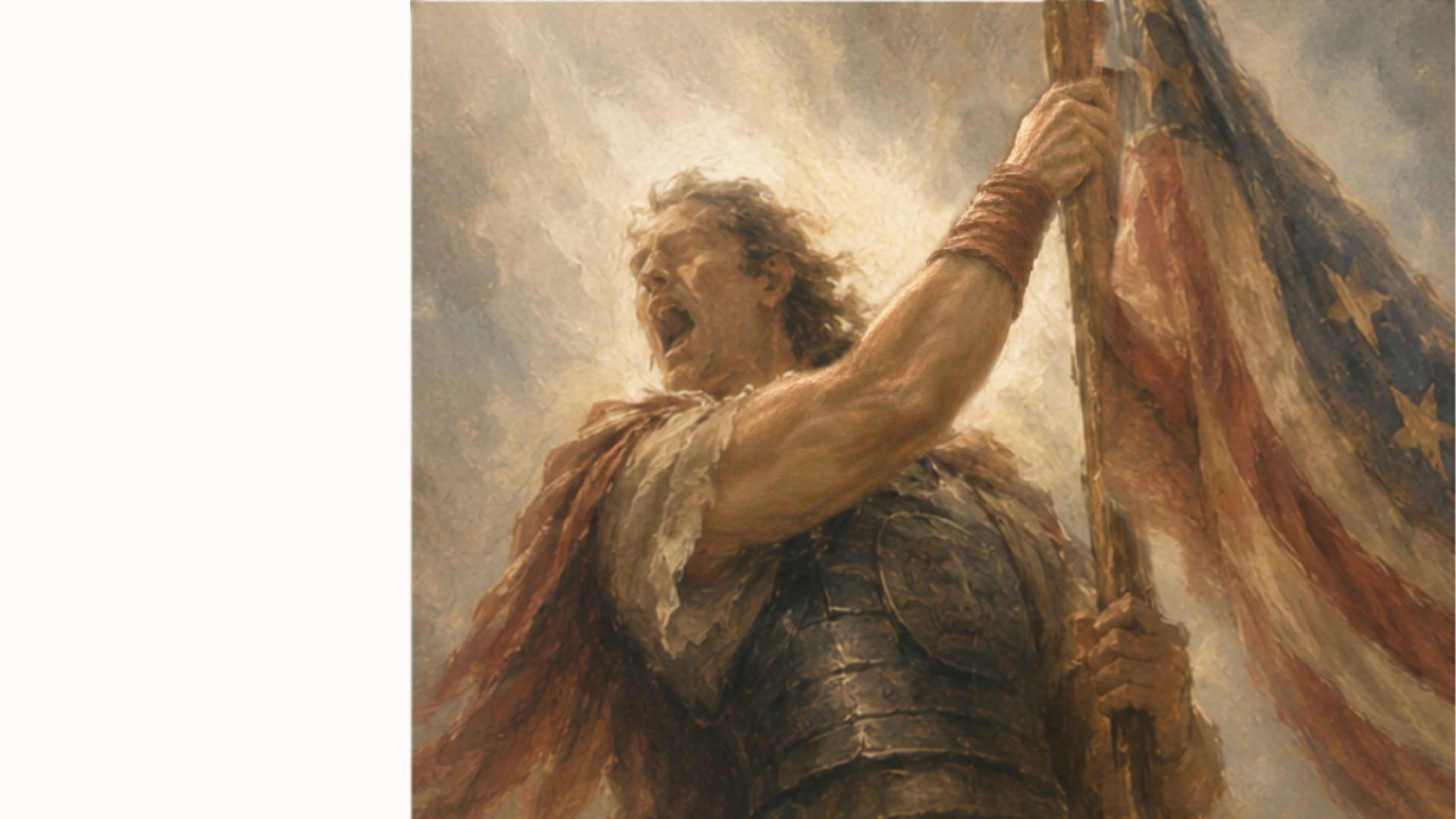
Captain Moroni raised the title of liberty by tearing his own coat. In our day, I think he’d find a banner someone else already dropped.
By Ken Krogue, with Rod Meldrum
The Question Every Generation Faces
There’s a banner lying in the dust. Most of us have walked right past it.
Every generation of believers faces the same question, and ours faces it louder than most: how do you defend the Church or this country without becoming defensive, or worse yet, offensive?
I’ve watched believers answer it badly. I’ve done it myself.
Ten years ago I found more than 240 pages of the faithful attacking each other by name over where the Book of Mormon happened, while critics held up our quarrel as proof that it never happened at all. The book, they said, was never history.
Well, I know it happened. It is history.
And it is prophecy.
This month I was tempted to answer badly all over again. Rod Meldrum talked me out of it.
This piece is about the answer. I keep finding it in the same place: a man with a torn coat.
A Banner in the Dust
I keep coming back to Captain Moroni. He rent his own coat. Think about that. He wrote the covenant on the clothes off his back: “In memory of our God, our religion, and freedom, and our peace, our wives, and our children” (Alma 46:12). Then he went out among the people waving it, and they came running (Alma 46:19–21). He didn’t recruit. He walked. They came.
Years later, when the government at home failed his soldiers, he warned that he would come, and he did. He marched inland toward the capital and raised the standard of liberty in every place he entered (Alma 60; 62:4–6).
Look at what he wrote. Our God and our religion: faith. Freedom and our peace: liberty. Our wives and our children: family. Faith, freedom, and family, written on a torn coat and carried on a pole. Every civilization that has lived on this land has had to decide whether those three still belong together. Moroni’s answer was to hold all three up in one hand, high enough for everyone to see.
Three full civilizations have lived on this land under that same covenant. Adam’s children. The Jaredites. The Nephites.
All three came and went.
Not one measured up. The Nephites even had Moroni’s banner flying from every tower in the land (Alma 46:36). Four and a half centuries later, they let it fall. And the land kept its terms every time: serve God, or be swept off (Ether 2:9).
We are the fourth.
The question in front of us is the same one that was in front of them. They answered it with their lives. So will we.
It’s time we start walking.
But it won’t look the same in our day. If Captain Moroni stood here now and saw what’s happening among us, he wouldn’t tear another coat. He wouldn’t need to. He’d find a torn and frayed banner that matters to all of us, already dropped and lying in the dust. He’d pick it up. And he’d march inland. Our designer Emily Shay has captured the depth of his heart and his courage in that moment, and I hope we can live up to it.
Notice the first two words on the title of liberty: In memory. Moroni wasn’t inventing a cause. He was calling a people back to the covenant they’d forgotten.
We still say that word every Sunday. The sacrament prayer asks us to “always remember him” (D&C 20:77). Moroni’s banner and the sacrament table say the same thing: remember what you promised. The banner calls a nation to remember. The sacrament calls a person to remember. One word holds both.
Yes, it was a call to arms. But what kind of arms?
Here’s the answer, and the rest of this piece is about what it requires.
We don’t pick up the banner to fight people.
We pick it up to call them home.
First, I believe, it’s a call to arise, O sleeper: to awake, to become aware. George Whitefield carried that very call through the colonies, and a generation woke up before a nation was born. Lehi pleaded with his sons, “Awake, my sons; put on the armor of righteousness” (2 Nephi 1:23). Nephi’s brother Jacob, reading Isaiah to his people, cried it three times: “Awake, awake” (2 Nephi 8:9, 17, 24). The third time, he tells Zion to put on her strength and her beautiful garments.
Then it’s a call to righteousness itself.
“And it came to pass that I, Nephi, beheld the power of the Lamb of God, that it descended upon the saints of the church of the Lamb, and upon the covenant people of the Lord, who were scattered upon all the face of the earth; and they were armed with righteousness and with the power of God in great glory.” (1 Nephi 14:14)
Notice Nephi doesn’t just say armor. He says armed: the weapon and the armor both. Righteousness is the armor. The power of God is the weapon, and Paul named its blade: “the sword of the Spirit, which is the word of God” (Ephesians 6:17). Alma learned it cuts deeper than steel. The preaching of the word “had had more powerful effect upon the minds of the people than the sword” (Alma 31:5).
Before we go there, one more Moroni. The son of Mormon watched his father die trying to call a people back to God. Many are asked to give their lives. Moroni was asked to live his, alone, write it all down, and stand guard over it for fourteen centuries, until he could bring it to a boy.
Captain Moroni stood in public and carried the banner where everyone could see it. His namesake worked alone, for people he would never meet. Both carried the banner. Most of us will be asked to do one or the other.
My favorite person in the Book of Mormon is his father. Mormon searched every record and pulled out the golden nuggets. Most readers take the milk and stop there (Alma 12:9–11). But eventually you have to open the hood. Is it a four-cylinder or a Hemi?
So let’s open the hood.
Armed With Righteousness
Rod says the Book of Mormon “was not written for its geography, but for its prophecies.” He’s not the first to say it. In 1890, President George Q. Cannon of the First Presidency wrote that the Book of Mormon “is not a geographical primer.”
One of my favorite apostles, Elder David A. Bednar, came at it from the other side in October 2024 general conference: ask why the Lord had Mormon put in what he did, because it was written for us.
I agree. So did the prophet Elder Bednar was echoing. President Ezra Taft Benson said it in 1986: “The Nephites never had the book.” Think about that. They lived it, but they never read it. “It was meant for us.”
Here’s one of those prophecies. Right before Nephi is told to write no more, he sees the saints and the covenant people of the Lord, scattered across the earth, “armed with righteousness and with the power of God in great glory” (1 Nephi 14:14).
There are the arms Moroni’s banner calls us to. Not swords. Not sarcasm. Not memes. Righteousness and the power of God. And the Lord gave us the rules of engagement: “Contend against no church, save it be the church of the devil. Take upon you the name of Christ, and speak the truth in soberness” (D&C 18:20–21). Truth, and soberness. Those are the arms too.
Elder Bednar made a promise about it in 2021: honoring covenants “arms us with righteousness and with the power of God.”
Then Nephi watches what comes next: “wars and rumors of wars among all the nations and kindreds of the earth” (1 Nephi 14:15).
How many nations? All of them.
That’s a world war.
Then the day “the work of the Father shall commence” (1 Nephi 14:17).
What work of the Father?
Six centuries later, Christ came to this land and answered that Himself. After His first day among the Nephites, the people didn’t sleep. They went out through the night to bring their families and friends, so they’d be in the place where He would show Himself the next morning (3 Nephi 19:2–3). They wanted a front-row seat.
And on that second day, He told them. “Then shall the work of the Father commence”: the gathering of His scattered covenant people, every tribe, even the ones that were lost, home (3 Nephi 21:26–28). The same words Nephi saw, now in the Savior’s own mouth.
In that same sermon He named it: “a great and a marvelous work” (3 Nephi 21:9). Isaiah had already seen it coming: “a marvellous work and a wonder” (Isaiah 29:14).
This is one of four examples of what I call the Laws of First Mention. Before Nephi ever copies a full chapter of Isaiah into his record, he tells us in his own words what Isaiah means. And the first time the marvelous work appears in the Book of Mormon is right here, in the same vision, seven verses before the armed saints: “I will work a great and a marvelous work among the children of men; a work which shall be everlasting” (1 Nephi 14:7).
The first mention tells you how to read every mention after it.
The marvelous work. The wonderful work. The work of the Father.
We’ve walked through all three of those days, verse by verse, on SearchIsaiah: The Three Days Nephi Saw Before He Was Told to Stop Writing.
What struck Rod and me as we read it together is this: the goal isn’t simply to watch wickedness fall. It’s to bring His people home.
That’s why we pick up the banner.
A Prophecy From Christmas Day, 1832
Nephi isn’t the only prophet who saw war poured out on all nations. Joseph Smith received what we now call Doctrine and Covenants 87 on December 25, 1832, twenty-eight years before South Carolina seceded and more than twenty-eight years before the Civil War began.
He named the state. Twenty-eight years early.
Watch how the circle widens. The wars begin “at the rebellion of South Carolina” (v. 1). Then “the Southern States shall be divided against the Northern States, and the Southern States will call on other nations, even the nation of Great Britain.” Britain, in turn, “shall also call upon other nations, in order to defend themselves against other nations; and then war shall be poured out upon all nations” (v. 3). One state, then a divided nation, then Great Britain, then other nations, then all nations.
Read the next line slowly. The Lord says the inhabitants of the earth will mourn “until the consumption decreed hath made a full end of all nations” (v. 6).
And the circle hasn’t closed.
Isaiah saw a civil war in the last days: “I will set the Egyptians against the Egyptians: and they shall fight every one against his brother, and every one against his neighbour; city against city, and kingdom against kingdom” (Isaiah 19:2). In our prophetic interpretation, Egypt is America. We make the case in When Isaiah Says Egypt, He Means America.
Joseph saw it too. Not one civil war. Two.
The first, he named. South Carolina, Christmas Day, 1832. He named it again in 1843: “the commencement of the difficulties which will cause much bloodshed previous to the coming of the Son of Man will be in South Carolina” (D&C 130:12). It came in 1861. More than 600,000 dead.
The second, he saw before the first. March 1831: “every man that will not take his sword against his neighbor must needs flee unto Zion for safety” (D&C 45:68). Neighbor against neighbor. Isaiah’s word. And the only people not at war one with another will be the ones gathered to Zion (D&C 45:69).
Joseph’s revelations carry the weight. Two men who knew him add their witness.
David Whitmer, one of the Three Witnesses, said it out loud to the Deseret News in 1878. A visitor asked him when the temple would be built in Independence.
“Right after the great tribulation is over.”
What tribulation?
“A civil war more bloody and cruel than the rebellion.”
A later family account adds another reported witness. In an 1896 letter, Nephi Packard said his brother Noah had heard the Prophet told him the next great war after the Civil War would start in “a little town now called Chicago.” Back then, Chicago was barely a town. Joseph said it would grow into “a very large city.” Nephi sent that account to A. Milton Musser. It is a later recollection, not a contemporaneous transcript of Joseph’s words.
Isaiah. Joseph’s own revelation. A witness of the Book of Mormon. A man who heard the Prophet with his own ears.
Four voices. One warning.
The first civil war is history.
The second is prophecy.
Then comes the instruction, and it’s the same answer Nephi gave: “Wherefore, stand ye in holy places, and be not moved, until the day of the Lord come” (D&C 87:8). Armed with righteousness. Standing in holy places. The weapon in the last days is the same in both books.
Two books. One answer.
Roll Out the Banner
Like Elder Bednar and President Benson, we’ll treat the Book of Mormon as a book of prophecy for our day, not just a quarrel over a map. We’ll stand in holy places: our homes, our temples, and this land itself, once it has been cleansed. We’ll be armed with righteousness and with the power of God, and nothing else. And we’ll serve the God of the land, who is Jesus Christ (Ether 2:12), until He brings His people home to the Father.
So start this week. Read Alma 46:12–21 aloud at dinner. Then ask everyone at the table one question: What would you write on your coat?
The banner is lying in the dust.
We intend to pick it up.
And we intend to start walking.
Roll out the banner of truth.
Walk with us. Read The Trowel and the Musket here on The Path, and subscribe to get each one as it’s published.
Sources (for the reader who wants to check)
- President Ezra Taft Benson, “The Book of Mormon—Keystone of Our Religion,” general conference, October 1986
- Elder David A. Bednar, “With the Power of God in Great Glory,” general conference, October 2021
- Elder David A. Bednar, “In the Space of Not Many Years,” general conference, October 2024
- David Whitmer, interview by Dr. P. Wilhelm Poulson, Deseret News, August 16, 1878, p. 2
- Nephi Packard, letter to A. Milton Musser (later assistant Church historian), July 24, 1896, A. Milton Musser Papers, Church History Library
- Rod Meldrum, “The Scriptural Basis for Book of Mormon Geography,” Book of Mormon Evidence, March 26, 2026, bookofmormonevidence.org/the-scriptural-basis-for-bom-geography/ (introduction)
- President George Q. Cannon, Juvenile Instructor 25, no. 1 (January 1, 1890): 18–19